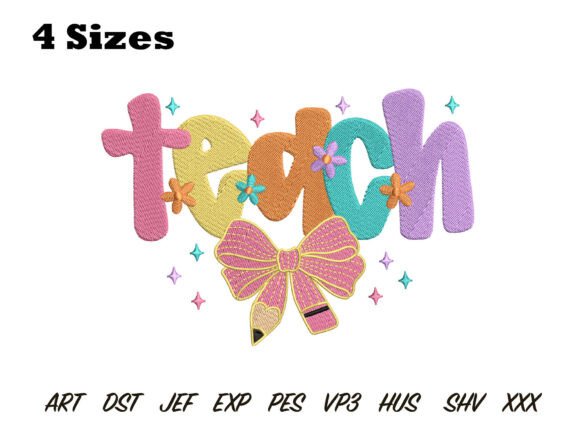
Teach with Bow Embroidery Design
A Practical Review for Small Business Merchandise & Branded Patches
As an embroidery designer who’s developed and tested hundreds of machine embroidery designs for small business clients—from indie bakeries and florists to creative studios and pet brands—I approached Teach with Bow Embroidery Design with a very specific question: Does this design translate into real-world brand assets—not just decoration? The answer is yes—but with thoughtful application. Its playful, whimsical energy (as described in the product copy) lands authentically, especially for businesses that lead with warmth, approachability, and handmade charm.
First Impression: Friendly, Intentional, and Professionally Whimsical
“Teach with Bow” immediately signals heart-led service—ideal for educators, mentors, therapists, or any small business rooted in guidance and care. The bow motif suggests celebration, attention to detail, and gentle authority. It’s not cartoonish or overly juvenile; instead, it balances softness with structure—making it equally at home on a boutique apron as it is on a school-themed tote bag. For businesses in the School category, it avoids cliché while still communicating nurturing expertise. That duality is rare—and valuable.
Where It Shines in Real Business Use
This machine embroidery design excels where personality meets practicality:
- Embroidered patches: Works beautifully as a sew-on or iron-on patch for staff jackets, tote bags, or product packaging accents—especially when paired with neutral thread colors like navy, charcoal, or cream.
- Staff uniforms & aprons: As a chest logo or sleeve accent, it adds distinction without overwhelming. Its balanced proportions hold up well on woven cotton and twill fabrics common in custom apparel.
- Cap embroidery: When sized appropriately (typically 2–2.5 inches wide), the bow’s curves and clean lines read clearly on curved surfaces—no distortion if digitized thoughtfully.
- Tote bag design & boutique merchandise: Scales elegantly to 4–5 inches for canvas or linen totes, reinforcing brand identity through repetition across customer-facing items.
- Etsy branding & handmade product labels: Adds visual consistency to craft-based businesses—think floral subscription boxes, ceramic studio tags, or pet brand bandanas—without sacrificing authenticity.
Where to Apply Caution
Like any digital embroidery file, Teach with Bow Embroidery Design demands context-aware execution:
- Small patch sizes (under 1.5 inches): Fine details—like subtle bow loops or narrow stems—may lose definition. Always test stitch-out at intended size before bulk production.
- Curved surfaces & textured fabric: On caps or knit polos, ensure proper underlay and stabilizer selection. High-pile or loosely woven fabrics require additional cutaway or tear-away support.
- Dark uniforms & frequent washing: Opt for high-contrast thread colors (e.g., white or pale yellow on navy) and confirm thread quality supports durability. Avoid ultra-fine satin stitches in high-wear zones unless reinforced.
- Stitch density & lettering: If the design includes script text or tight interior curves, review stitch count estimates—if not provided, request them from your digitizer or vendor. Overly dense areas can cause puckering on lightweight fabrics.
How It Strengthens Brand Identity & Customer Trust
In a crowded marketplace, Teach with Bow Embroidery Design does more than decorate—it communicates intention. Its gentle confidence tells customers: We care about craft, clarity, and connection. That perception directly impacts perceived value: a café using it on barista aprons signals pride in service; a florist stitching it onto gift wrap tags reinforces artisanal care. Unlike generic clipart-style motifs, this design feels curated—not templated—enhancing professionalism and buyer engagement. When repeated across touchpoints (caps, totes, packaging), it builds visual consistency that supports recognition—even without a full logo lockup.
Essential Embroidery Designer Notes for Commercial Use
Before committing to production, here’s what I always verify—especially for commercial embroidery projects:
- Test in black and white first: Assess contrast and legibility without color distraction.
- Confirm small-size performance: Stitch out a 1.75" version on your target fabric to check clarity and hoop compatibility.
- Review thread color contrast: Match thread tones to your brand palette—but prioritize readability over exact matches on dark substrates.
- Inspect spacing & underlay: Tight loops or intersecting elements need proper jump-stitch management and stabilizer support.
- Verify hoop size requirements: Some versions may need larger hoops—critical for multi-position cap or jacket work.
- Test on real fabric: Even with perfect digitizing, fabric texture changes how stitches lay—always sample.
- Use appropriate stabilizer: Cutaway for stretch knits, tear-away for stable wovens, and fusible for lightweight linens.
- Create a printable mockup: Present stitched samples alongside lifestyle photos to clients before final approval.
- Compare beside other design assets: Does it harmonize with your existing logo, typography, and brand voice—or compete with it?
- Confirm commercial licensing: Ensure your purchase grants rights for resale, branded merchandise, and small business merch use—don’t assume.
Ultimately, Teach with Bow Embroidery Design isn’t just another embroidery file. It’s a versatile, emotionally intelligent asset—one that elevates apron embroidery, cap embroidery, and tote bag design with quiet confidence. When applied intentionally, it transforms everyday items into meaningful extensions of your brand story. For small business owners, Etsy sellers, and craft-focused brands, that’s not decoration. It’s differentiation.